Money is made in Pennies — Behavioral Insights into Drip Pricing
An essay to make you a smarter consumer.
Imagine yourself in a small, dark room with no source of light coming in from anywhere. You light a candle. Suddenly, the things around you begin to illuminate. Slowly, your eyes adjust to the surroundings. It isn’t that dark anymore. Now imagine you keep doing this, lighting one candle after another, until you have 99 burning. When you finally light the 100th candle, your eyes can’t tell which part of the room that extra light is illuminating. The problem isn’t with your eyes — it’s with the change itself. Compared to the overall brightness already present, the difference is so small that it becomes unnoticeable.
Such is the limitation of human cognition. There is ample evidence that humans are often more sensitive to how their current situation differs from some reference level than to perceiving the absolute change (If you want to read further about this, go here). This information is what the sellers capitalize on to make you spend more than you are willing to.
Before we dive into how, let's first understand the purchasing behavior of people (If you want to read the research around this, go here). My goal here is to make this research as intuitive as possible.
Stages of purchasing.

A consumer typically goes through four phases of purchasing, each one bringing you closer to owning the product (remember this — we’ll see why later). We won’t focus on the post-purchase phase, because at that point you’ve already given your money to the seller, so it’s out of scope for making you a smarter buyer. Our focus will be on the first three phases.
Need Phase
The word “need” here isn’t philosophical. It’s simply a realization — something you lack, or something you think you lack — followed by the conscious choice to want it. This realization can happen in two ways:
- Internally: hunger, sleep, impulse, etc.
- Externally: a TV ad, your neighbor’s new PS5, a radio jingle, and so on.
This is the phase where you can either pursue the need or drop it entirely. For this essay, let’s assume you want a PS5.
Pre-Purchase Phase
To put it simply, this is where you start exploring options — Google, ChatGPT, offline stores, and so on.
Here I want to introduce you to something called the cost of search (“ct”). Cost of search can mean many things, but for intuition, think of it like this: you earn $50 an hour. If you spend 4 hours hunting for the cheapest PS5, you’ve already lost $200 in time. So even if you find a PS5 for $250, what you’re really spending is $450 to get it.
And this extends beyond just time. With this information in mind, your brain starts running optimizations and shortcuts, convincing you that you’ve done a thorough search — and that the one on Amazon is the cheapest. (Even though Amazon was only the second place you checked!)
This is also the stage where you start questioning whether you really need the product. But depending on the kind of buyer you are, you might already be daydreaming about swinging through the city in Spider-Man. This is exactly where you need to pause and apply some rationality.
What Does a Rational Consumer Do?
The trick here is to play devil’s advocate. Challenge the presumed utility of your purchase with rational questions: Will I actually have time to play it regularly? What are the top five games I truly want to play? If it’s only one game, wouldn’t it be smarter to just rent a PS5 instead? Is my time actually worth 50$? Shouldn’t I search more?
These questions bring you closer to the real value of owning a PS5, instead of a biased or emotional one.
Purchase Phase
This is the stage where you actually go ahead and make the purchase. You decide how much you’re willing to spend, when you want to buy it, and when you want it in your hands. Sounds simple? Well, not so much — this is where companies make money in pennies.
Money in pennies — The proof
Below is a sample screenshot of PS5 as shown on Amazon.com. Let’s break this down:
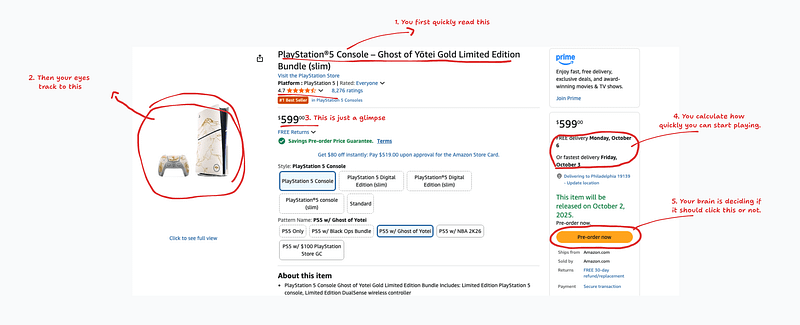
The numbered sequence in red shows how you’d typically scan this page. You don’t carefully read every detail — instead, your eyes do a quick sweep to grasp the essentials. The main takeaway here is that you found a PlayStation for $599, which you now perceive as the cost to own one.
Adding to Cart
You click Place Order. You’re just one button away from playing Spiderman, and then… boom! This is what you see:
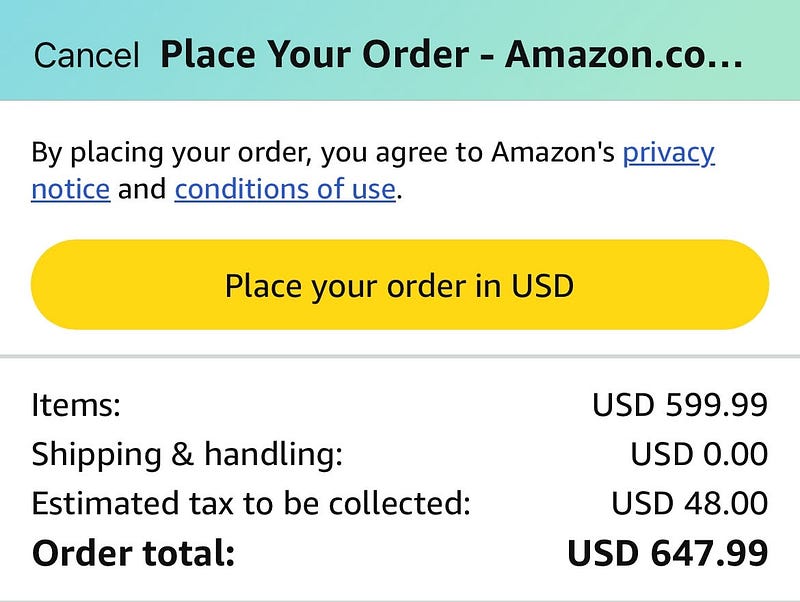
How much will you actually spend?
That $599 console suddenly turns into $647.99 — an extra $48 added at checkout.
Now, let’s pause and reflect on your state of mind at this point in the purchase journey:
- You’ve already convinced yourself you want it after much internal debate — you even know exactly which game you’ll play first.
- You’ve learned the PS5 will arrive in just 3 days — you’re already imagining yourself playing.
- You’re only a click away from owning it — the anticipation feels almost unbearable.
- You’ve invested time researching options. Rejecting this $48 add-on means going back to square one — revisiting the pre-purchase or even the “need” phase and restarting the entire search process.
- By this point, you’ve already entered your address and other details. If you abandon the purchase and switch to another site, you’ll have to start all over again.
This is precisely the moment when several cognitive biases take hold:
Endowment Effect — Once you’ve placed the console in your cart, you already feel like it’s yours. The value you attach isn’t just the console itself — it’s the memory and emotional anticipation of finally playing Spiderman.
Sunk Cost Fallacy — Commonly seen in gambling: “I’ve already spent x, might as well spend x + 48 for the payoff.” In this case, x isn’t just money — it’s also the time you spent researching, the effort invested in choosing, and the mental cost of letting go of the purchase.
Payment Decoupling — The $599 price tag could have dampened your excitement. To maximize enjoyment, your mind subconsciously separates the money from the product — focusing on the experience rather than the cost.
Adding to cart, then, isn’t just a checkout step — it’s a psychological trigger. It activates these biases beneath the surface, making you feel a sense of ownership before you’ve even paid.
Now, let’s bring in price elasticity. It shows you how flexible you are with the price varying upwards or downwards — and this is a direct function of what you pursue as the value of owning the product:
π=V(owning)−V(actual cost)
As long as π > 0, you’re willing to pay — even if the price creeps upward — because the perceived value of ownership outweighs the actual cost. And here, “owning” isn’t just dollars. It also includes search time, effort, and emotional energy.
This kind of pricing — where an additional cost is revealed late in the purchase process — is how companies quietly earn in small increments. Let’s look at a few more examples of this before we put a label on the strategy.
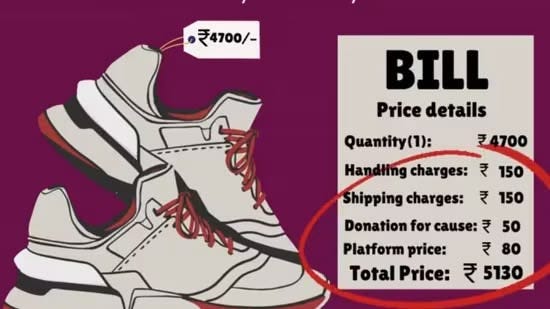
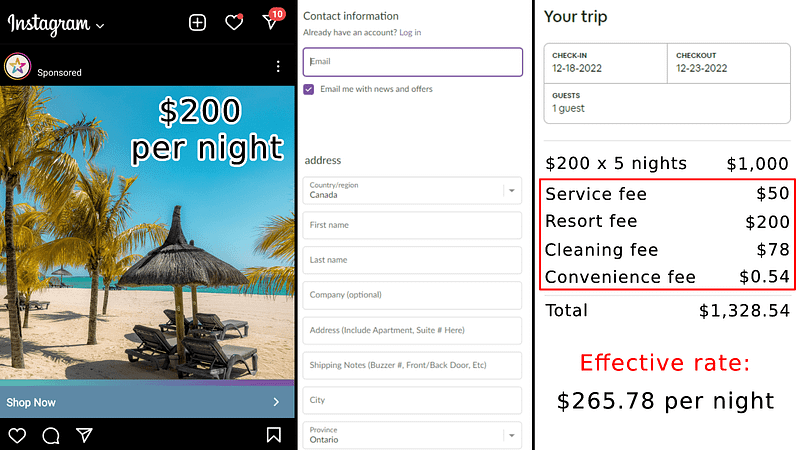
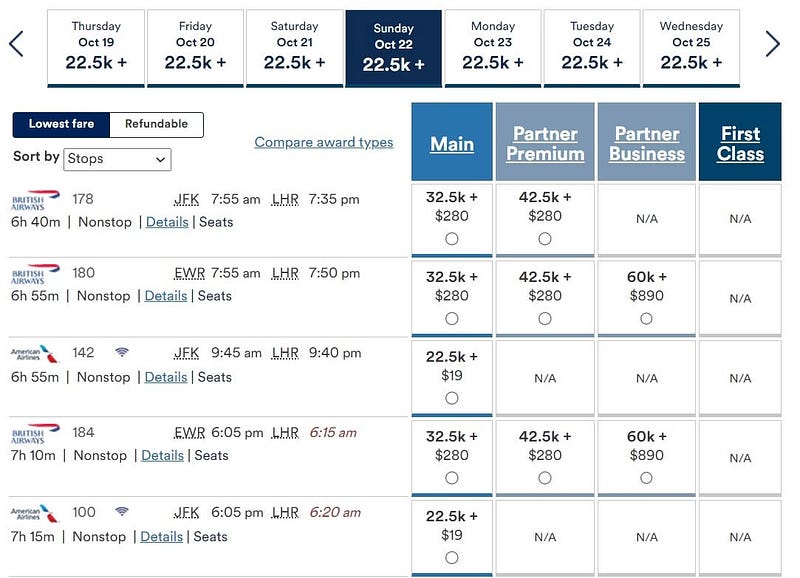
You’ve probably come across this before — and been annoyed by it — but this is exactly what’s known as the Drip pricing strategy.
So what is this drip?
Remember the candle example from the beginning? The crux of drip pricing is simple: make you invest time and effort into a process, then slip in incremental charges at the end. By the time you notice, you’ve already sunk so much into the checkout that it feels easier to keep going than to start over.
Think of someone who’s ready to pay $599 but suddenly sees an extra $48 tacked on. Annoying, yes — but walking away now would mean wasting all that effort. That’s the psychological lever drip pricing exploits.
Common examples include:
- Airline seat selection, baggage fees, and priority boarding.
- Service and delivery fees on Amazon, Instacart, and other platforms.
- Apple shipping iPhones without chargers — forcing an extra purchase.
- Grocery stores charging for bags.
- Travel insurance when buying tickets.
And the list keeps growing: hotel “resort fees,” ticketing “convenience charges”, and even ride-hailing apps adding “safe ride” or “surge” fees. All of these rely on the same principle — small drips that quietly fill the final pool of money you pay.
Why does this work the best?
Now let’s flip the lens to the seller. In a highly competitive market, prices naturally converge toward equilibrium — most e-commerce sites end up looking roughly the same, with only slight differences. That means margins per product are razor-thin. To compensate, sellers first get you to commit to the purchase and then gradually tack on extra charges, raising the final price and protecting their margins.
If you want to read a highly technical and detailed report on different pricing strategies, check it out here.
So what can we as consumers do?
You need to reframe how you see the prices.
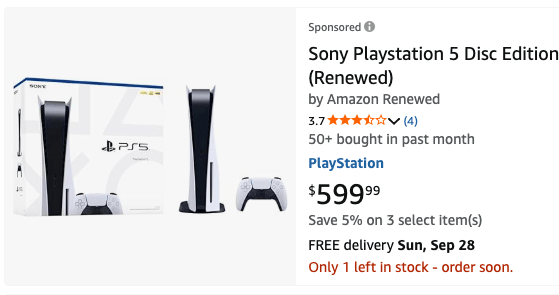
So the next time you shop and see a price like this, remember — you’re not really paying $599. That number is an illusion. What you’ll actually pay is the real total you get after doing a bit of quick math:
- Round up 599.99 to 600 — it is not 500
- Add 30$ to the new amount (This would be the median of all possible additional values you might have to pay)
So the effective price of this purchase is 630$. Now you have a new reference line to compare with, and no, it is definitely not cheap.
I hope this essay gave you the intuition to see how sellers nudge you into spending those extra bucks for their penny profits. Drip pricing works because psychology is on their side — once you’re invested, those small add-ons feel easier to accept than starting over. The next time you spot it, pause, do the math, and recognize the real price behind the illusion. Happy shopping!
Originally published on Medium on Sep 23, 2025. Text and publication date preserved from the original.