The Psychology of Originality and Authenticity in the Age of AI
This is going to be a short one (hopefully), but high information density.
There’s a growing stigma around using AI to generate text or create content, as if relying on it somehow makes your thoughts less original or your intelligence less authentic. I believe that’s a false narrative, one that completely misunderstands the nature of knowledge in the age of intelligence amplification.
Tools like these don’t erase creativity; they redefine the skills that matter. When Uber arrived, driving became less about mastery and more about access. Similarly, you no longer need to understand the intricate hand signals of a trading floor to participate in the stock market. Just as literacy once expanded who could record and share ideas, AI now democratizes knowledge and capability. It dismantles the old gatekeeping of expertise, empowering more people to think, express, and build without first needing to master every technical craft.
The other day, I was speaking with a dear friend who goes by Pranav, and naturally, our conversation drifted to the rapid evolution of AI. He mentioned an intriguing line from Jensen Huang, NVIDIA’s CEO: “Software Is Eating the World, but AI Is Going to Eat Software.”
That instantly reminded me of Marc Andreessen’s famous declaration that “Software is eating the world.” And he was right, we’ve already seen how software devoured hardware. The value of most devices today is defined not by their physical form, but by the software that animates them. Hardware has become the vessel; software, the essence.
So what happens when AI begins to replace software itself? The very purpose of software is to perform tasks, nothing more, nothing less. If AI can perform those tasks directly, do we still need the intermediaries we call “apps”? We began envisioning a world without apps, a world where simple, context-aware models handle everything fluidly, without the clutter of interfaces or menus.
That’s when my friend introduced me to the idea of AI as an amorphous blob of intelligence.
Imagine a sphere that knows of all that was, is, and will be — a multi-agent orchestration in motion; countless agents thinking, weaving, creating as one. A civilization of coordinated intelligence, resting at your fingertips. At first, these agents build the software that builds the world — generative systems creating tools as they go. And once all the tools ever needed are created and understood, then the tools are no longer needed.
Think of it this way: you’ll no longer open an app, run a program, or follow a structure; you’ll simply interact, and the system will adapt, understand, and act. No interface, no code, no tool — only intention, translated effortlessly into action: the purest form of intelligence at work. Almost like a reflex or subconsciousness.
Fascinating, isn’t it? The very thought left me absolutely mesmerised by the potential it holds for humanity.
Now, about those bold headlines, “AI will take over the world.” I’ve always found that to be an impossible fantasy. What AI will truly do is restructure what we traditionally identify as “jobs.” And in doing so, it will offer something even greater, the chance to reclaim time, the one resource that is finite.
Imagine automating the mundane parts of your life, the repetitive, mechanical tasks, and winning back the most precious resource of all: time. Time to create, to reflect, to connect. That, to me, is the real revolution.
(And yes, I’ll stop myself before I fall deeper into this rabbit hole but feel free to continue it in the comments.)
AI and Optimising Language
Our conversation eventually turned to how language is perhaps the most suboptimal form of communication and how, one day, it might no longer be needed. This is where I agree and disagreed with him. Agree that it is suboptimal, but disagree that it will eventually be redundant. The issue isn’t language itself; it’s the limitations within it. And that, I believe, is precisely where AI will have its greatest impact.
The very purpose of language is communication, and communication is at the heart of human evolution. I believe the emergence of language was one of humanity’s greatest evolutionary leaps, a cognitive catalyst as transformative as the mastery of fire. It is communication that gave us the ability to coordinate, collaborate, and build civilizations. Every invention since has simply been an extension of our ability to communicate.
Picture this:
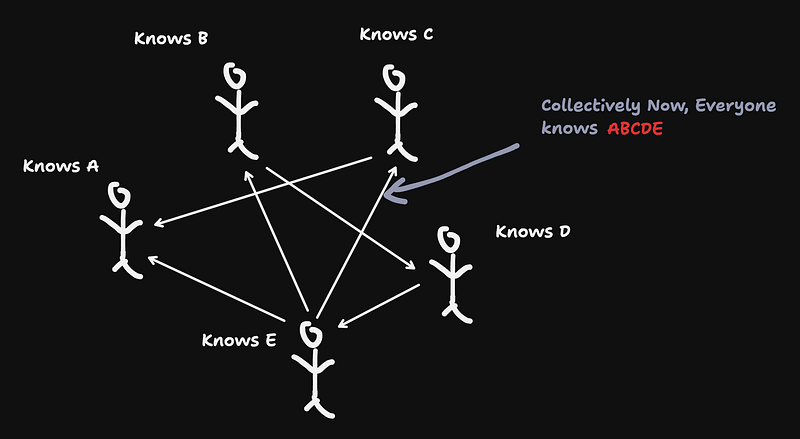
This exponential replication of knowledge allowed us to coordinate at the highest possible level, overcoming the biological limits of evolution. It elevated us far above the natural hierarchy, enabling us to thrive and sustain ourselves indefinitely, for as long as our capacity to communicate allows.
But language, too, comes with its own limitation. I’m reminded of Thomas Kuhn’s reflection on scientific progress:
“Scientific revolutions are inaugurated by a growing sense… that an existing paradigm has ceased to function adequately in the exploration of an aspect of nature to which that paradigm itself had previously led the way.”
The same can be said of language. It has, in many ways, ceased to function adequately in the exploration of communication, the very domain it once revolutionized.
In the diagram above, every “knows” represents knowledge but that knowledge becomes constrained by translation into consumable language and the verbosity it demands. Think of thought as a Lamborghini stuck behind a pickup truck, unable to switch lanes. By the time you pen down an idea, the speed of your thought has already been throttled by the mechanics of language.
I often find myself performing suboptimally in interviews. When an interviewer poses a question, my mind gets busy computing all possible solutions, yet I’m expected to respond using words to communicate. For that to happen, my cognition has to reallocate resources from thinking to translating: converting thoughts into language, language into text, and text into words I can actually speak. It’s like trying to do math while walking a tightrope.
Every human is constantly reinventing the wheel of grammar, structure, and syntax every moment just to convert thoughts into something others can understand. To compensate for this, people, especially in interviews, often start mumbling even before they’ve finished thinking. You see how paradoxical that is? There have been so many times I’ve gotten so busy structuring my thoughts into language that I lost my train of thought entirely.
With the advancement of AI, however, we are beginning to strip away this limitation.
For the first time in history, we can offload the act of translation. You no longer need to structure your thoughts before expressing them, you can simply pour them into a large language model and ask it to reshape them into structured, coherent language. (And yes, I did use this very method to purely structure this piece!)
We are, in a sense, operationalising thought. For the first time, ideas can move faster than the bottleneck of expression. Instead of criticising the use of AI for communication, especially in academia or creative fields, we should recognise it as the natural next step in human evolution: the outsourcing of linguistic friction.
AI doesn’t replace thinking; it removes the tax on expressing thought. Once the scaffolding of language is automated, we reclaim the cognitive resources once spent on grammar, syntax, and structure, freeing the mind to focus purely on ideas.
And that brings me to what I believe should guide the future of this field:
Every future innovation in AI should aim to optimise and operationalise language, to make it flow at the speed of thought, not limit it. Because only when our tools catch up to our cognition will we truly begin to communicate at the full potential of the human mind.
A Letter of Gratitude and Caution to the Architects of Intelligence
I feel deeply humbled to witness and coexist with the brilliant minds who are shaping this amorphous sphere of knowledge. The sheer imagination and intellect required to conceive something so transformative is awe-inspiring. To simply belong to the species capable of creating this feels like a blessing.
Yet, with such creation comes responsibility. The joy of discovery finds meaning only when anchored in shared human values. Think of AI not as a possession, but as a natural resource, like the air we breathe or the sunlight that warms our skin. Its power should flow through everyone, not just a privileged few. Imagine the potential of humanity we will unlock simply by by giving this power to every single human being. The probability of unlocking something even greater, maybe even divine will multiply exponentially!
AI is not a tool for dominance but a gift to humanity. Its true power will endure only as long as humanity itself endures. What makes life worth living is not intelligence alone, but the bonds of trust, kindness, and love we cultivate the invisible network effect of human connection.
Imagine the potential of humanity we will unlock simply by giving this power to every single human being. The probability of uncovering something even greater, perhaps even divine, will multiply exponentially.
So, to every inventor and dreamer shaping this field: focus not on how powerful you can make AI, but on how many lives you can touch, how many smiles you can spark, and how much time you can return to others.
Thank you, sincerely, for this creation.
I’d love to connect on all things human behavior and design. Reach me at arjun10@sas.upenn.edu for some conversations. And if you want to pick Pranav’s brain, here is his Linkedin.
Originally published on Medium on Oct 17, 2025. Text and publication date preserved from the original.