Gamifying Abandoned Cart Recovery: A Behavioral Experiment in Consumer Decision-Making
I recently revisited my long list of unfinished Medium drafts, stories and ideas I never got around to sharing. So I’ve decided to set aside a few hours each week to finally bring them to life, to share, to get critiqued, and to grow through the process. I hope you enjoy reading them as much as I’ve enjoyed writing them, and I’ll do my best to keep them as engaging as possible.
18. 70.
I’ll come back to those numbers in a bit, but first, let’s talk about abandoned carts.
They’re a menace to both buyers and sellers. You know the drill: those desperate follow-up emails, “You’re one step away from checkout!” or “Would you like to continue your order for The Happiness Hypothesis?”
To put “how much” into perspective: according to the Baymard Institute (2024), the global average cart-abandonment rate is around 70%, leading to an estimated $18 billion in lost sales annually. And that doesn’t even count the costs of failed recovery attempts, the reminder emails, retargeting ads, and incentive discounts that often go nowhere. These are the 18–70 numbers I mentioned earlier.
Economically speaking, e-commerce functions as a two-sided matching market (Rochet & Tirole, 2003), where platforms must continuously balance value between buyers and sellers. In theory, such markets achieve optimal efficiency through continuous auctions, dynamic exchanges where prices evolve through real-time negotiation. But replicating that offline bargaining energy across millions of digital buyers would be computational chaos. So, we default to fixed prices, a trade-off between scalability and engagement.
So we settle for fixed prices, a compromise that often fuels the very problem we’re trying to solve: abandoned carts. (Of course, there are other factors at play, but we’ll save those for another day.)
So the question is, how can we create a middle ground?
A system that doesn’t turn into a chaotic, real-time auction, yet still lets buyers find a better deal and helps sellers move their products faster.
I call this concept the Price Pool, and here’s how it works.
Anticipation Without the Auction: The Price Pool
At its core, the psychology behind auctions can be boiled down to two powerful motivators:
- Fear of Missing Out (FOMO)
- Social Proof and Status
The Price Pool borrows from this very foundation; it’s not a full-blown auction, but it captures the same anticipation and collective excitement.
It draws on Cialdini’s (1984) principles of social proof and scarcity: people look to others to validate value, and Loewenstein’s (1987) idea of anticipation utility, where the build-up before a reward generates its own psychological satisfaction. The Price Pool leverages both; it isn’t an auction, but it recreates the same emotional tension and excitement that make auctions so compelling.
Here’s how it works at a functional level (we’ll explore the buyer’s and seller’s perspectives later):
- The Seller sets the floor price: the lowest rate at which they’re willing to let the product go.
- A future date is fixed for when the pool goes live. Think of it like a product drop on Product Hunt, an event, not a discount.
- Random selection: People who already have the product in their carts are randomly chosen and notified about the pool, along with the final sale price. They can choose to join, ignore, or just watch.
- Once they join, they can either opt for autobuy, meaning the product will automatically check out the moment the pool opens, or
- Choose “notify me”, so they get an alert when the sale begins and can decide on the spot.
The Fun Part: Gamifying the Pool
To make it engaging (and not just another flash sale), the Price Pool integrates insights from behavioral game design. Each design layer borrows from cognitive-psychology research on attention and motivation: scarcity elevates perceived value (Verhallen & Robben, 1994), countdowns exploit temporal discounting tendencies, and exclusivity triggers the Zeigarnik Effect, unfinished goals stay mentally “open,” keeping users attentive and eager to return.
- Short Lifespan: Each pool runs for only 30 minutes (maybe even less, this part’s still up for testing). The short window taps into urgency and FOMO, making participation feel special.
- Exclusive Access: Only those who joined the pool get to buy during the first 30 minutes. Others can watch but can’t act yet, a small design trick that fuels anticipation and social comparison.
- Engineered Scarcity: The number of people in the pool will always exceed the number of available items. It’s not manipulative, it’s calibrated to recreate the rush of high-demand moments like ticket sales or limited drops.
- The Queue for Everyone Else: Once the 30-minute private window ends, remaining products (if any) open up to the public queue. Everyone can see the live metrics, how many are left, how many are buying, how many are waiting to buy, creating an ongoing cycle of social proof and collective urgency.
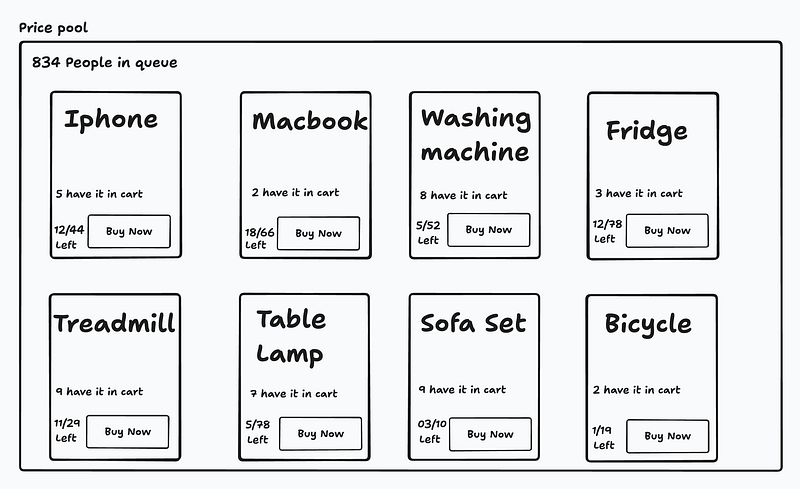
Okay, below is a very, very bad mock-up of how the flash sale might look 😅. Don’t judge the design, it’s just to get the idea across! I’ve talked more about the underlying design tricks in another blog, you can check it out here.
What Does It Mean for the Seller?
(I am assuming this is already at play in major e-commerce platforms)
For sellers, the challenge is often knowing what to discount and by how much. Pricing decisions are not always rational; they’re emotional. Sellers experience what behavioral economists call the Endowment Effect: once they own a product, they tend to overvalue it, making them reluctant to lower the price.
To counter this bias, sellers need better information, not intuition. Here’s how:
- Visibility: Give sellers a clear view of how many abandoned carts currently contain their products, and show them the potential profit if those carts were converted. This makes demand tangible rather than abstract.
- Analytics: Equip sellers with insights that map sales performance against price. Let them see at what price points their products historically performed best, and how much stock should be allocated to a pool to generate momentum without flooding the market.
When sellers understand demand patterns in real time, they’re more willing to play the pricing game, and everyone wins.
Behavioral Biases at play: Buyer, Seller, and Spectator
Let’s look at this system through three different lenses: the Buyer, the Seller, and the Spectator- and explore the behavioral biases that make this marketplace move faster.
The Buyer
- Anchoring:
When buyers are first exposed to a higher price, any later discount feels like a win. The original price acts as an anchor, making the pool price instantly more attractive. - Endowment Effect:
Simply joining a pool creates a subtle sense of ownership, “it’s already mine.” That emotional attachment makes buyers far more likely to complete the purchase once the sale opens. - Perceived Agency:
Unlike static pricing, the pool gives buyers a sense of control. They feel they’ve earned a better deal by acting at the right time, not just passively accepting a listed price. - Audience Effect:
The presence of spectators fuels motivation. Just like in live auctions, people tend to act more decisively when they know they’re being observed. - Social Proof:
Seeing others waiting in the queue or joining the pool signals that “this product must be worth it.” That perceived demand drives urgency and validation. - Timed Discounting:
When there’s a visible countdown, “Only 12 minutes left!”, the ticking clock adds time pressure and pushes buyers toward action. - Loss Aversion:
At the heart of FOMO: the pain of missing out feels worse than the satisfaction of saving. Buyers often purchase just to avoid that regret.
And underneath it all runs the Hooked Model, a behavioral loop that keeps both buyers and spectators returning:
Trigger → Action → Variable Reward → Investment
A notification acts as the trigger. Joining (or even observing) is the action. The ever-changing mix of discounted products becomes the variable reward. And the small investment of time and attention deepens engagement, making users more likely to join again.
The Seller
- Salience:
Demand becomes visible, not abstract. Sellers can literally see how many carts hold their product, turning invisible intent into tangible opportunity. When demand feels real, action follows. - Choice Architecture:
The seller dashboard reframes decision-making. Instead of guessing, sellers can now compare clear payoff trade-offs: “What happens if I launch a pool today versus waiting?” This structured visibility nudges better pricing decisions. - Present Bias / Certainty Effect:
When potential revenue is presented as an immediate and concrete opportunity (“You could sell 50 more units if you open this pool”), sellers are more likely to act now rather than hold out for uncertain future sales.
The Spectators
They come in two forms: those discovering the Price Pool for the first time, and those who knew about it but chose not to join.
The observer dynamic activates well-studied social mechanisms, social facilitation (Zajonc, 1965) and observational learning (Bandura, 1977), where merely watching others act increases the likelihood of imitation in future rounds.
Both groups are crucial to the system’s psychology; they’re the silent participants whose emotions shape the next round of engagement.
- Anticipation:
Watching others compete builds tension. The more emotionally invested a spectator becomes, the stronger their desire to act when the next opportunity appears. - Anticipated Regret:
This is the classic “I should’ve joined” moment. Seeing items sell out in real time triggers regret, and that regret quickly transforms into motivation to join the next pool. - Temporal Discounting:
The short, 15-minute waiting window before the sale goes public adds urgency. The delay makes the potential reward feel even more valuable, nudging spectators toward impulse buying once the gate opens. - FOMO:
Even without participating, spectators experience the fear of missing out. Over time, repeated exposure makes them more likely to join future pools just to avoid that feeling again.
Parting thoughts
Like any model, this one comes with its caveats. (And if you spot more edge cases, feel free to drop them in the comments. I’d love to hear them.)
- Price-Elasticity Risk: There’s always a risk that users who might have purchased at full price shift downward to the pool price, an instance of demand cannibalization. The challenge is to balance higher conversion rates against reduced margins.
- Product Fit: There isn’t yet a clear framework for which products should go through this model and which shouldn’t. Some categories might respond beautifully; others, not so much.
This is, for now, a hypothetical model; it hasn’t been tested in a live market yet. But there’s a strong opportunity here: Future A/B testing across e-commerce environments could quantify these trade-offs, measuring elasticity, regret, and engagement metrics, to validate whether behavioral triggers like FOMO and agency genuinely drive sustainable sales lifts.
In essence, the Price Pool offers a middle ground, a pseudo-bargaining system that doesn’t require the complexity of continuous auctions, yet still brings back the human elements of choice, anticipation, and play. And as always, behavioral design is as much about responsibility as creativity: nudges should clarify decisions, not coerce them.
I’d love to connect on all things human behavior and design. Reach me at arjun10@sas.upenn.edu for some conversations.
Originally published on Medium on Oct 27, 2025. Text and publication date preserved from the original.